


How to play rock-paper-scissors in japan
Yes, this is U-shi-.
In this article, I would like to explain how to play Japanese rock-paper-scissors.
Have you ever played Japanese rock-paper-scissors-scissors?
It is called janken in Japanese and, in Japan, this game is played when you want to win or lose something.
最初はグー じゃんけん ポン
(sai showa gu jyan ken pon)
We play rock-paper-scissors with these calls.
If you can play this game, your Japanese friends will surely say ” Great!
I have explained how to play Janken on YouTube in the past.
Please watch this article and video to master how to play rock-paper-scissors!
Now, let’s get to the explanation.
How to play rock-paper-scissors
There are two things I want you to remember about Japanese rock-paper-scissors.
The first is what guu-choki-paa means.
The second is the shout and how to do it.
I’ll explain in detail.
what does guu-choki-paa mean?
First, what does guu-choki-paa mean?
I’d like to explain about this.
First, let’s talk about guu.
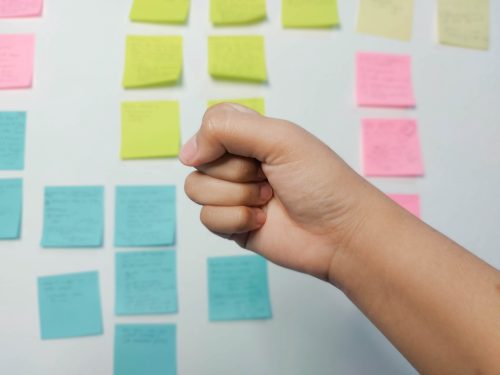
To make a guu, make a fist with your hands tightly clenched like this
This is rock.
Gu represents a stone.
This will be important later on, so please remember it.
Next is the choki, and from the guu position, thrust your index and middle fingers upward.
This is the same as the peace sign.
This is choki.
Choki means scissors.

Remember this, too.
And finally, paa.
Paa is the shape of an open palm.
This is paa.
Paa represents paper.

Remember this too.
I’ve explained the guu-choki-paa so far.
Next, I’ll explain the chemistry of each of the guu-choki-paa.
First, I’ll summarize what each guu-choki-paa represents.
Guu is stone, choki is scissors, and paa is paper.
Can you imagine their affinity?
I’ll show you a picture here.
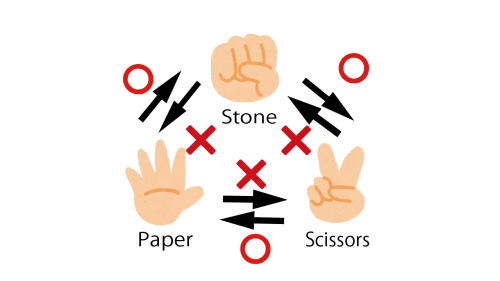
This image is a diagram of guu-choki-paa plus their respective affinities.
Let me explain.
Stone is strong with scissors, weak with paper.
Scissors are strong against paper and weak against stones
Paper is strong against stone and weak against scissors
It will be easier to understand if you think of it this way.
I hope you now understand what guu-choki-paa represents and what it is strong against and weak against.
Calling and how to do it
Now I would like to explain the second part of the exercise, the shouting and how to do it.
I think it is important to practice this out loud, so I would like you to practice out loud.
To be honest, it would be easier to understand if you watch YouTube, but I will try to explain it clearly so that you will be able to play rock-paper-scissors-scissors just by reading this article.
So let’s do it.
Watch the video.
The video shows the characters for Janken (さいしょは ぐー じゃんけん ぽん).
The top one is in hiragana and the bottom one is in romaji.
Let’s practice until we get to the circle (○) first.
After I pronounce the word, please try pronouncing it out loud.
Next, read the part behind the circle (○)
Pronounce the word from beginning to end.
I hope you all have learned the call.
Now let’s say the call three times together.
Excellent!!!!!!!!
How to play Janken
I will now explain how to play rock-paper-scissors-scissors.
You give gu when sai showa gu that you just learned.
Say “Janken”, and at the same time, when you say “pon”, make a hand in one of the shapes of “guu-choki-paa” .
Here’s how I do it
Here’s a bad example for you.
Everyone, when you sai showa gu, please give gu.
This is a promise.
Have you understood so far?
The next section explains what happens when all the hands played by the participants in a rock-paper-scissors-scissors game are the same.
in this case of あいこ(aiko, happens when all the hands played by the participants in a rock-paper-scissors-scissors game are the same)
First, let me explain the wordings.
When all the hands played by the participants in a janken game are the same, the name of the situation is called aiko.
For example, if two players are playing rock-paper-scissors, and both players make the same hand, there is no winner or loser.
I will explain what to do in that case.
If both of you play the same hand shape, we’ ll say “ai kode syo(あいこでしょ)” and try to play the next hand shape.
I’ll try it alone.
In the end, U-shi-‘s right hand was a paa and his left hand was a guu, so the right hand paa won!!
We will do this until we win or lose.
Now let’s pronounce ai kode syo.
Finally, let’s try to pronounce the word “ai kode syo” with me at the same time.
You’re good.
Perfect.
Now you can play Japanese rock-paper-scissors-scissors!
Lastly
I know some parts were difficult, but I hope you will watch this article and my videos again and again so that you can learn how to play Japanese Janken.
コメント